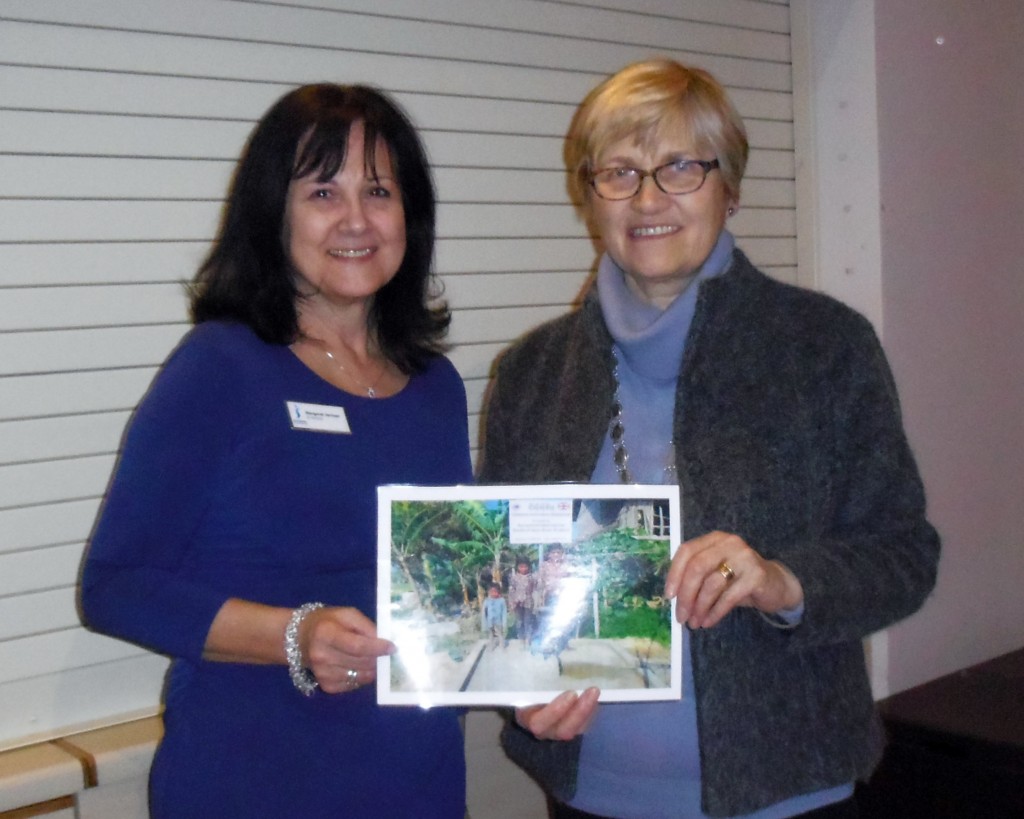
Margaret Jarman, member of SI Solihull, spoke movingly of her involvement in the Cambodian Child Dream Organisation (CCDO). A chance meeting brought her into contact with Jenni Lipa (New York), Founder and President of CCDO. Impressed by the speed and efficiency with which the organisation built and dedicated a well in memory of her recently deceased husband Margaret became closely involved with the organisation and established a UK branch. Their main mission is to promote sustainable village development in partnership with Cambodian people by helping to provide clean water, sanitation, educational opportunities, health care from birth onwards, improved nutrition, and economic empowerment. The cost of helping these rural war-ravaged communities is modest: water wells (£170) latrines (£150), child annual school fee (£90), bicycle for school (£35), school starter kits (£15) anti-child-trafficking comic books (£30/class; £60/community). Education of small children in hygiene, anti-trafficking and domestic violence is achieved through shadow puppetry and comics. Several SI clubs have raised funds for water wells and latrines that are now dedicated in their name, including SIGBI and SI Stratford-upon-Avon.
http://www.cambodianchildsdream.org
January 2015
Karla McLaren gave us an excellent insight into the work of Amnesty International. Her references to projects in Afghanistan highlighted some positive developments for women in spite of a dominant climate of violence and fear with continuing segregation. 27% of MPs are now women (23% in UK); there are new laws against violence towards women; and there is access to education. But dreadful suffering is still being endured and Amnesty remains vigilant. Karla is Government and Political Relations Manager for Amnesty International in London and we were very lucky to have a speaker from their headquarters.
www.amnesty.org.uk
October 2014
Alison Lewis from the Warwickshire Family Nurse Partnership described their programme that provides intensive support for young (under 19) first-time mothers. Mothers are entitled to 65 home visits from a qualified nurse until the child is two years old and the baby’s father is also supported where appropriate. They are helped with parenting, health and well-being issues, and advisors also ensure educational needs of the parents are met to improve their opportunities in the workplace. Following successes in the USA this NHS service is now available in 100 counties in the UK. The Warwickshire team was established in 2010 and any money donated by our club will go towards supporting a young mother in Stratford who needs to complete her education to ensure a self-sufficient future for herself and her baby.
Family Nurse Partnership www.fnp.nhs.uk
South Warwickshire NHS Foundation Trust www.cyp.swft.nhs.uk/family-nurse-partnership
June 2014
At our June meeting local GP Dr Cristina Ramos talked about the disease endometriosis. This condition affects between 1.5 and 6% of women of child-bearing age and occurs when endometrial tissue from the womb lining finds it way to other parts of the body. It is not life threatening but can be both painful and very debilitating. The condition is treated with hormone therapy or by surgery.
Our awareness raising evening was brought about following a proposal at the last SIGBI conference in Newcastle to increase knowledge of the subject and to help women gain help. The charity Endometriosis UK have an excellent website ( www.endometriosis-uk.org ) and there is a support group in Kenilworth.
May 2014
Kerry Scarlett described the Adavu Project which aims to facilitate a local response to human trafficking in the West Midlands and beyond www.adavu.org.uk . It is a Birmingham Methodist District project, describing human trafficking as the movement of a person from one place to another into conditions of exploitation, using deception, coercion, the abuse of power or the abuse of someone’s vulnerability. Awareness is a key factor in success of anti-slavery work, and Kerry emphasised the importance of alerting police to concerns by dialling 101 or, where immediate action is needed, 999. Where anonymity is important Crimestoppers (0800 555 111) can be used. Adavu is a member of the West Midlands Regional Anti Trafficking Network consisting of people working for different organisations (statutory and non-statutory) all over the West Midlands, who might come into contact with trafficked persons through the work they do.
March 2014
Richard Jackson, manager of the Stratford Food Bank (SFB) gave some enlightening facts about users of the bank (www.stratforduponavon.foodbank.org.uk )which was established in 2013 and is now a registered charity. It is part of the Trussell Trust Food Bank network (www.trusselltrust.org ) . In the first year 1,100 food parcels were distributed by the SFB, and numbers are rising this year. Beneficiaries have to be referred by, for example, doctor or social services who provide a form to take to the Trust. They are met by a volunteer who stays with them for a chat and a cup of tea while another volunteer goes to get the food parcel. Reasons for need vary but include low income, redundancy, heating bills, family breakdown, issues with benefits etc. Few users are over 65: typical users are single and 30-40. Most use the Food Bank only once.
Donations: Opening Times 12 – 2.00pm Tuesday – Holy Trinity Parish Centre, Old Town Stratford upon Avon, CV37 6BG; Friday – United Reform Church, Rother Street, Stratford upon Avon, CV37 6LU. The Trust is hoping to move to a new centre in 2014. Contact 07884 418732 info@stratforduponavon.foodbank.org.uk
February 2014
Biggles is not just for boys: nor is engineering. Mrs Penny Stott, a regional co-ordinator of the Engineering Education Scheme of the Royal Academy of Engineering, spoke of her Biggles-inspired career as an aeronautical engineer that took her from a flight test engineer on military aircraft to a project engineer in industry where she identified opportunities for development. After retirement her enthusiasm for her work found an outlet in the Engineering Development Trust, which operates an education scheme partnering schools with local companies ( www.etrust.org.uk ). Pupils enhance their technical, personal and employability skills through industry-led projects, industrial placements and specialised courses. A typical six-month course ends with the opportunity to exhibit at a 3-day event that attracts top people in industry, which is ideal for building confidence and essential communication skills. Girls do well on these courses and are often surprised to find a career path they had not realised existed. Penny emphasised the importance of educating the educators to encourage girls who are good at mathematics and physics to consider becoming much-needed engineers.
December 2013
Music and Shakespeare: an inspiring relationship. Ted Watson described his 42 years with the Royal Shakespeare Company providing the music that Shakespeare brought into his plays. He described this era as an ‘age of song’ where good musicianship was seen as a sign of good education and good character, and Shakespeare regarded music as an important feature of his works. Each play – and each director – brought different challenges and required different musical instruments from the tin whistle to the rich tones of the bass clarinet. All had to be played on stage, and from memory. Several instruments were on display and we were privileged to hear each played with great accomplishment. We were entranced by such skill and musicianship
November 2013
Four members gave reports on the recent energising and motivating annual Federation Conference held in Gateshead. All attendees had felt privileged to hear Baroness Helena Kennedy and Lady Marie Stubbs talk about their lives and how they had been able to use their education and abilities to make a real difference to the society in which they live. Marie Stubbs had been given four terms to turn around the failing school where headmaster, Philip Lawrence had been murdered in the late 1990’s. She described how she had been able to create a positive environment where children felt safe and valued and were able to pursue their dreams.Other speakers at the conference were equally impressive, clearly illustrating the goals of Soroptimism by improving the lives of women and girls through education. Pontso Mafethe is the Women and Girls manager at Comic Relief and it was surprising to learn that projects that promote women’s rights are taken so seriously by the organisation. Other notable speakers were Jasvinder Sanghera, who has campaigned against forced marriages and Allie Marks from Mary’s Meals – a charity that enables children to attend school by supplying a nutritious meal each day.Club members also heard of other Soroptimist projects, ranging from mental health awareness in Ireland to providing clean water in Cambodia. As well as listening to inspiring speakers, the Club also heard that Soroptimists are changing practices to attract new members and keep people informed. Soroptimists have representation at the United Nations of which we are duly proud. Those attending had had both an enjoyable and inspiring time and urged all members to attend a conference in the future.
October 2013
Marking Breast Cancer Awareness Month Dr. Cristina Ramos, a GP at the Rother House Medical Centre, gave us a comprehensive overview of this condition. She covered the risk factors, symptoms, diagnosis, types of breast cancer, development stages and treatment. We were impressed by the in-depth discussions that took place between multidisciplinary consultants at the beginning of every case. Patients are then presented with options before treatment is commenced in accordance with their wishes. Dr. Ramos explained that a detailed risk analysis was done before considering any pre-emptive surgery. She recommended regular self-examination of breasts to check for any lumps or changes in tissue to enable early diagnosis and treatment, and encouraged all women to take advantage of the NHS mammogram screening programme. The Macmillan website has good information on breast cancer: http://www.macmillan.org.uk/Cancerinformation/Cancertypes/Breast/Breastcancer.aspx
September 2013
Petite Tamsin Walford looks more like a ballet dancer than a tough winchman dangling on the end of the rope of an RAF rescue helicopter. But that is what she did for five years. She gave an enthusiastic and inspiring overview of her time as the first female winchman on the RAF Search and Rescue (SAR) service. She described the individual responsibilities of the crew that must work as a team: 2 pilots, a winch operator and a winchman. Two Sea King Aircraft teams work 24 hour shifts when they can be called out for both RAF and civilian rescues. This may involve operations on high buildings, roads, fishing vessels, oilrigs, mountains etc as well as rescuing downed aircrew. This tough, demanding, highly skilled work carries great responsibility and requires intensive physical, technical, and medical training. The training and ability-testing is continuous to ensure the crews are always combat-ready for the unpredictable. Tamsin is the daughter of Club President Judy.
July 2013
Club members gave updates on some club projects.
Birthing in the Gambia is a SIGBI project, now in its third and final year. The first hospital has been renovated and updated to a standard that better meets the birthing needs of women in Gambia. Local staff have been trained so that they, in turn, can train newcomers to ensure that the hospital has a sustainable future. Regional Ambassador Rose Hutchinson (Stratford Club) suggested ways of raising further funds to contribute to this project. https://sigbi.org/our-charities/the-big-project
Datalink. This ‘message-in-a-canister’, sometimes known as the ‘green-cross scheme’ provides vital personal information in a small plastic canister kept in the fridge. If, in an emergency, paramedics, firemen, police etc. see a green cross on the fridge they will see that the canister travels with you to hospital. The information inside the canister tells the emergency teams who you are, any medication you need, people/pets who depend on your care, emergency contacts etc. Our club has raised money for the printing and awareness campaign for these canisters and we are now working with the local Lions club who are rolling the scheme out across the UK. http://e-clubhouse.org/sites/shakespeare
REMAP: custom-made equipment for people with disabilities. The last of our money raised for their charity has been paid to the local Coventry and Warwickshire branch. We were delighted to learn that this branch has been put forward to receive two REMAP awards. www.remap.org.uk
June 2013
Rosie Herbert, Assistant Principal of Stratford-upon-Avon College of Further Education, provided an overview of the college – the courses offered, the students that benefit and the way it interacted with local businesses. The college caters for 2000 full time students, mostly 16-18 year olds but some as young as 14 where requirements are catered for in conjunction with the normal school programme. The college specialises in the performing arts, technology-based subjects and catering science as well as covering standard GCSE and A level topics. Many students benefit from the practical aspects of the studies which are not available at schools, and enjoy the workplace experience offered. The college strives to improve literacy and numeracy of students alongside the hands-on subjects.
May 2013
Judith Humphry, headmistress of Welcombe Hills School which is our president’s charity for 2013, spoke with enormous enthusiasm about this school for young people with a variety of special needs. It takes 160 pupils aged 2-19 from the whole of South Warwickshire with various – and sometimes multiple – physical and communication problems. There are development opportunities in art, gardening, sport, away-days and the performing arts and they are proud that two pupils are doing GCSE Art. Judith emphasised the importance of including family and friends wherever possible and regards the school as a ‘school family’. Her talk was illustrated with photographs of pupils working in the art room which periodically gets converted to bygone times such as a medieval banqueting hall. All pupils undertake work experience at some stage either alone or in groups. Our club is raising funds to buy a kiln for the art department. www.welcombe-hills.co.uk
March 2013
To mark Fair Trade Fortnight (23rd February-10th March 2013) and World Water Day (March 22nd 2013) club Members Val Clark and Judy Klinkenberg gave talks on Fair Trade in Chocolate Production and Water Awareness respectively.
Val highlighted the plight of trafficked children used as slaves in harvesting cocoa for chocolate production and the steps being taken to eradicate the practice by the Fair Trade organisations www.fairtrade.org.uk www.fairtrade.net and the anti-trafficking organisation www.stopthetraffik.org . There is a depressingly long way to go before their aims are achieved and child exploitation is eradicated. She advised us to look for the Fair Trade logo when buying chocolate as some British retailers now have some accredited products.
Judy explained that her experience of spending some years in a remote part of the Sudan with two small children drove home to her the true value of water as a precious resource. She and her husband managed family life in a home with no sanitation or water in searing heat. The daily struggle to get fresh water for drinking and washing and the necessity of keeping infectious diseases at bay is an abiding memory: her photographs graphically illustrated the arid terrain. She subjected us to a challenging-but-fun quiz on water and hygiene and we were left feeling grateful indeed. www.wateraid.org/uk
October 2012
Dr Cristina Ramos, a GP at the Rother House Medical Centre, gave a detailed illustrated talk on gynaecological cancers: cervical, ovarian, vaginal, vulval and womb. 50 women a day are diagnosed with one of these cancers, and 20 die. She highlighted the importance of noting any unusual symptoms and emphasised that it is vital to seek help from your GP quickly: early diagnosis is essential for a good outcome. The Eve Appeal (www.eveappeal.org.uk ) is a UK charity that raises money to support world-class research at the Department of Women’s Cancer at University College, London, enabling new and innovative work. Key early signs and symptoms for each type of cancer are listed on the Eve Appeal website. To help their fundraising campaign to ‘Stop pussyfooting around and get your funny feet on’ club members wore unconventional shoes to the meeting and held a sales table to raise funds. Nearly £80 was donated to the Appeal.
August 2012
Hospice at Home was the theme of the talk given by Gillian Trench from the Shakespeare Hospice. Sensitivity to patient choice is the overwhelming driver for this wonderful free service that extends to areas within and beyond the four GP Practices in Stratford-upon-Avon. The small team of four dedicated nurses and one health care assistant provide physical, psychological, spiritual and social comfort to end-of-life patients and their carers. They ensure appropriate medication and pain relief and do their utmost to facilitate patient wishes and decisions: some choose to spend their last days at home while others prefer to be in a hospice or hospital. Complementary therapies are popular and patients benefit from massage, reiki, aromatherapy etc. The team has seen 95 new patients so far this year, all referred by their GPs. They work closely with the GP Community Nursing teams who have ultimate responsibility for care received. Gillian is a Specialist Practitioner and Team Leader of the Hospice at Home Service of the Shakespeare Hospice, a registered charity. www.theshakespearehospice.org.uk
July 2012
At our July meeting Deb Bignall from the Warwickshire YoungCarers Project (WYCP) (www.warwickshireyoungcarers.org.uk) spoke of the desperate plight of many children and young people who are main carers for incapacitated relatives at home. The person they care for may have an illness, a disability, or mental health or substance misuse problems. The caring often involves heavy physical work and in some cases inappropriate caring such as toileting or washing someone of the opposite sex. The young carers are frequently housebound when not at school with few friends, limited career aspirations, and poor communication skills: they are sometimes subjected to bullying at school. The WYCP offers support for these young carers from recreational breaks to help in contacting other services that may be able to relieve their burden. And they offer a valuable listening ear to reduce the loneliness and isolation so many children feel.
March 2012
‘I’ve never seen StarWars’ was the phrase that inspired President Penny to set us the challenge to do something we had never done before during her year. She set the ball rolling by having a manicure and going to the races (emerging £25.00 in pocket). At our March meeting three Club members told us of their ‘first time’ events. One took to the skies in a hot-air balloon and, quite by chance (the wind deciding the route), passed over the houses of two other club members, the place that she worked and the golf club used by a friend – and photographs were produced as proof. Another member did two things: had lunch at Claridge’s followed by tea at the Ritz; and went to Long Lartin maximum security prison as Prison Visitor and is now on their register of Visitors. And the third member went to an auction for the first time and, following the advice on the programme Flog It, successfully bid for a ‘job-lot’ of seven of the most beautiful fans.
February 2012.
Science, Suffrage and Sisterhood was the theme of biochemist Professor Robert Freedman’s talk. Women were not welcomed in the club-like scientific circles in 1911 but this was the time of suffragettes and there was a parallel movement of strong spirited women breaking barriers and determined to join the Biochemical Society on equal terms as men. Harriette Chick (1875-1977) was the first to be accepted. She had an illustrious career with notable work on disinfection and nutrition. She was the first woman member of the Lister Institute and became a fellow of the Royal Society aged 85. Many women biochemists of this era were educated at King Edward VI School for Girls in Birmingham where the inspirational headmistress , Muriel Wheldale (1888-1931), actively encouraged science as a career, sending 5-6 women every year to the University of Cambridge to study science. She was a noted biochemist herself and was the first to apply the newley published theory of genetics, proposed by Mendel, to the pigment of plants. The talk was illustrated by a poster exhibition first shown last year at the Royal Society and about to go on a Road Show round the country. Robert is better known to us as husband of President Penny.
October 2011. ‘A woman must have money and a room of her own if she is to write fiction’. These words, written by Virginia Wolf in 1928, inspired Sarah Hosking to found an unusual charitable trust to provide residential fellowships for mature women artists of established merit. The Hosking Houses Trust, established on the outskirts of Stratford-upon-Avon, currently offers a sanctuary for women over 40 to complete written work, on any subject, that has reasonable expectation of publication and preferably with an existing contract to do so. All running costs of the housing are provided by the Trust and also a degree of financial support sufficient to allow uninterrupted private work. The only requisite is that the Trust is acknowledged in the published document. www.hoskinghouses.co.uk
September 2011. Peter Sutton – linguist, translator, editor, playwright and author – spoke on the use of the English language and how it constantly changes and evolves. He cited recent examples of verbs used as nouns (having an invite); adjectives used as nouns (I am good) and the use of words such as focusing, targeting and progress as verbs. Each decade brings new words and the rapid growth of texting is giving us a whole new language. Mr Sutton finished by reading aloud three wonderful examples of writing by young people, demonstrating their skilled and imaginative use of our rich language.
May 2011. Club member Shelagh Sandle gave us an overview of her year as mayor of Stratford-upon-Avon. It had, she said, been a humbling experience meeting so many people who contributed so much to our society. Her talk touched on many experiences, but it was the talented young people who seemed to have left a lasting impression. She much enjoyed providing a link between residents and Local/District Authorities and will miss the inspiring people she met during the year.
March 2011. The meeting was preceded by a talk from Carole Lomas, Voluntary Services Manager of the Shakespeare Hospice. She spoke of the hospice’s ambitious 5-year plan to take their services into the heart of the community, increasing their in-home services. She described her volunteer services that include the Day Hospice; Family Support Service; Complementary Therapists; Bereavement Support; Shops; Administration and Fundraising.
February 2011. The meeting was preceded by a talk by Celia Davis, President of Warwickshire Beekeepers, who gave a delightful overview of ‘Bees in our Garden’. She described the different types of bee – one honeybee, the rest are bumblebees – and their particular habitats, amply illustrated with informative pictures. She emphasised the importance of bees in pollinating flowers and their value in evolution of healthy stock. Bees annually pollinate £20M worth of crops in the UK. Their fragile existence depends on flowers throughout the season, from willow catkins, pulmonaria, grape hyacinths and fruit blossom in the spring, through single-flower plants in the summer and autumn.
November 2010. The meeting was preceded by a category talk by club member Sarah O’Grady. Sarah is a solicitor specialising in commercial law and litigation. Her career began in private practice as an advocate dealing with such things as fraud cases. She now works for the Head Office of the Environment Agency in Bristol as their senior commercial lawyer, leading a team of four. She described with enthusiasm her work on business support, environmental schemes including carbon trading, intellectual property issues, income recovery and contract support including collaborative agreements.
October 2010. The meeting was preceded by a talk by Peter Balaam, S/A District Councillor, on The Ecumenical Accompaniment Programme in Palestine and Israel (www.eappi.org ). This programme sends international volunteers to Israel and the Occupied Palestinian Territories of the West Bank to offer protection through non-violent presence and support for peace groups whilst monitoring violations and undertaking advocacy. Peter was in the West Bank (Palestine) for three months and spoke of his experiences.
September 2010. The meeting was preceded by a talk by Mike and Maureen Worton who described their charity Chernobyl 2000 formed to help the children of Belarus in the Ukraine following an explosion at the nuclear power plant on 26th April 1986. Their aid convoys help the cancer-support group run by parents; Minsk Oncology Hospital; Uzda Family Social Centre; Uzda Regional Hospital ; Uzda Fire Service and schools. They organise exchange-visits for Belarussian and Evesham schoolchildren. This will be our President’s charity 2012-13.
August 2010. The meeting was preceded by a talk by James Pavitt from Transition Stratford who is working at the Lifeways Community Garden in Albany Road, Stratford. He explained the many initiatives being undertaken by Transition Stratford to encourage residents and local services towards a locally based, low carbon way of living. Information on activities can be viewed on www.transitionstratford.com .
July 2010. The meeting was preceded by two talks.
1. Jo Porter from the Cotswold School, Bourton-in-the-Water repeated the presentation she gave at the recent SI Midland Arden Region Public Speaking Award on Equality. She argued that the balance had now swung in favour of women in the UK today, sidelining men in the ‘state of being equal’.
2. Christine Cluley, a Gallery Interpreter at Compton Verney art gallery, spoke with enthusiasm of its development by the philanthropist Sir Peter Moores, son of the Littlewood pools/catalogue owner. She described the permanent collections, and highlighted some forthcoming exhibitions and events including the Volcano exhibition from 24th July.
May 2010. The meeting was preceded by a talk by Barry Wiggins and Gary Wooding from the Coventry & Warwickshire branch of Remap, a countrywide charity that offers free custom-made equipment for people with disabilities. They showed examples of their work ranging from simple pumps, levers and supports to complex computer software. By imaginative use of existing materials the branch kept their costs to only £250.00 last year. Remap is our President’s charity this year. www.remap.org.uk