
This session incorporated four eminent speakers followed by a panel session in which they all answered questions from the audience. All the blogs from the four parts of this session are below.
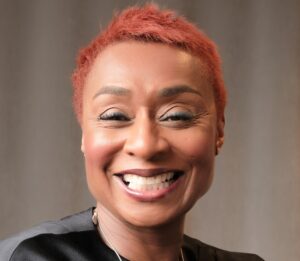
Michelle Griffiths Robinson
 Blog by Jane Slatter, SI St Albans
Education for Change: Inspiring Action, Impacting Lives
We were all looking forward to hearing from Olympic athlete Michelle Griffith Robinson whose inspirational talk exactly fulfilled the brief of this conference. Michelle is a mother of three, a life coach and a very proud ambassador of Women’s Aid in the UK.
Family is really important to her, inspired by her own mother. She left a photo of her lovely family on the screen for the whole presentation, choosing to speak from the heart, telling her story without visual aids. It was lovely to hear the personal connection that Michelle is the niece of Soroptimist Sharon Dixon – what an amazing network we’re part of!
Michelle describes herself as “the girl from Wembley who dared to dream big”. Her father didn’t want her to go into sport, he wanted her to concentrate on her education, so she chose to do both!
Age 19 she was breaking triple jump records, age 24 her life changed with the letter inviting her to the 1996 Olympic Games in Atlanta, representing the UK in the first women’s Olympic triple jump event ever.
Age 30 she started to acknowledge to herself that she was in an abusive relationship. She knows now that she is a survivor. It took therapy for her to understand that she was not to blame and she needed to leave. It was this experience that led her to advocate against the violence and abuse of women and girls.
Abuse doesn’t happen to someone else – it can happen to anyone.
Everyone deserves a life free from fear. She says leaving was a difficult decision “who looks after the woman who is always looking after someone else”. Therapy taught her that real confidence is knowing your worth so you are free to live your life as you choose it to be.
She said for violence against women and girls to end we must start before it happens. We must teach children what healthy relationships look like.
She believes through her work with Women’s Aid that collectively we can change things for the better, but awareness is not enough. Leaving abusive relationships is complicated – survivors need people, services and systems to support them that are designed with survivors at the core. She gave us four things that must happen:
- Challenge all harmful behaviour – “call it out” (note from editor book to attend Suzy Lampugh Trust online Bystander Training)
-
Recognise the signs of abuse – learn and teach.
-
Listen without judgement.
-
Teach healthy relationships as early as possible.
She said “I’m not an expert, but I want to make a difference” – something in common with all Soroptimists! She told us to care, listen and act.
So many wonderful soundbites:
“You are not to blame for someone else’s decision to abuse you. You are so much more than what has happened to you.”
“I am unapologetically me.”
“We need men and boys to call it out and be part of the change.”
“Every woman deserves to feel safe.”
She gave us some horrific stats:
- 1 woman every week is murdered by her partner in the UK.
- One third of women experience abuse in their lives (probably higher).
- There are more than 10,000 women and 11,000 children supported by refuges in the UK and 140,000 women and 180,000 children receiving community based services for domestic abuse.
Michelle says in her role she has been privileged and humbled to meet the French rape survivor Giselle Pelicot and proud to call survivor and Spice Girl Mel B her friend of 26 years and Patron of Women’s Aid.
Michelle challenged us to think about our action plan for when we leave Conference – what will we do?
Michelle ended by saying “there is no stopping me, I’m going to call it out and collectively we will make a difference.” She said meeting with women like Soroptimists gives her HOPE!
What a treat it was for us to be motivated and inspired by “the girl from Wembley who dared to dream big”.
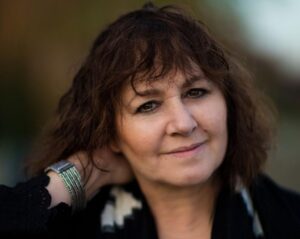
Leslee Udwin
 Blog by Farah Abdool, SI Esperance
Teaching Children to Love
Some speakers inform you. Others change how you think about a problem you have worked on for years. Leslee Udwin, filmmaker, human rights advocate and education activist, did both. Her delivery was passionate, courageous and unflinchingly honest, and the room was with her from the first sentence.
Her four key messages
1. Films can raise awareness, but we need action and prevention.
2. Culture programs misogyny, and what is learned can be unlearned.
3. The window for teaching empathy is early childhood, before the age of 6.
4. Think Equal is a proven, affordable way to do it.
From filmmaker to education activist
Leslee opened with a bold statement: we need men and boys to challenge misogyny. She took us back to the 2012 gang rape and murder of a young medical student in India, which sent millions of men and women onto the streets in protest for weeks. Leslee went to India to make a film amplifying those voices, India’s Daughter, but within days she doubted it, wondering what an awareness-raising film could possibly achieve. “We have enough awareness about gender-based violence,” she told us. “We need action, solutions and preventative interventions.” India’s Daughter is the last film she will ever make.
Then came an idea: if she could understand the men who did it, perhaps she could work out how to change them. She spent seven months interviewing the convicted rapists. She spoke with great courage about her own experience of sexual violence at the age of 18, which she told no one for twenty years, and reminded us that one in five of us has experienced rape or attempted rape.
Not monsters, but programmed
She expected monsters. What she found were men who had been programmed. Two were sensitive men, and none was the psychopath she had imagined. Their explanations were strikingly similar: the woman was out after dark, she was with a man who was not her father, and they had a “duty” to teach her a lesson. This does not excuse their crimes, but it shows how learned beliefs shape behaviour. Only one of the men had finished secondary school, and the rest had left between the ages of 11 and 14. When she interviewed the lawyers on the case, some voiced views even more chilling than the rapists’.
Her conclusion was that culture programs misogyny. From the sweets handed out when a boy is born to the quiet disappointment when it is a girl, inequality is learned very early. “If they can learn to hate, they can be taught to love.”
The right kind of education
Leslee returned to Nelson Mandela’s words on education as our most powerful weapon, and asked what kind of education she meant. Not the kind designed for the Industrial Revolution to fill factories, but one that teaches children to love.
She gathered global experts, including the late Sir Ken Robinson, who responded to her idea by asking how this had never been done before. Others were Montessori educator Barbara Isaacs, neuroscientist Prof. Richard Davidson, and Urvashi Sahni, who empowers girls through education and challenges toxic masculine stereotypes. Their message was about timing:
● About 90% of the adult brain is built by age 5.
● Emotional control and habitual responses are largely set by age 6.
No architect would build a skyscraper without foundations, Leslee said, yet that is what we do with our children. Literacy and numeracy are not enough. In her words, if we do not change mindsets, we change nothing, and this is how we will tackle gender-based violence, war, suicide and mental health disorders.
Think Equal
The result is Think Equal, an early years programme that teaches the “missing subject” of social and emotional learning:
● A 30-week programme covering 25 competencies, including empathy, gender equality, emotional literacy, kindness, self-awareness, environmental awareness and advocating for others
● Three sessions a week, with lesson plans and just two days of teacher training
● Tools such as the “mood meter”, which helps children plot and name their emotions
● A trauma-informed level for emergencies and refugee settings, including work in Palestine
● A mobile app and home kits so parents can join in
Leslee was passionate about teachers, whom she believes matter more than presidents or prime ministers, and whom we do not value enough. Early years teachers are already programmed to nurture, and Think Equal gives them purpose and tools.
Does it work?
Three randomised control trials, in Botswana, Australia and Colombia, found anger and aggression falling, empathy rising and gender stereotypes shrinking. Early intervention of this kind is also linked to a 10–25% increase in adult incomes, so it makes economic as well as moral sense. In the panel discussion she added that one year of prison for a violent offender costs as much as putting 5,800 children through the programme.
Think Equal has reached 1 million children in 42 countries and 59 languages. Sixteen of those countries have made it compulsory for every child. The programme is also supported by UK Prime Minister, Andy Burnham.
How she closed
Leslee ended with a message of hope from the parent of a five-year-old Think Equal learner in Somalia. He had wanted his son to be strong and thought that meant being loud and never backing down. The programme taught them both that true strength is empathy, controlling anger and solving problems. His son now helps his younger sisters unprompted and mediates disputes in the street. This, the father said, is “an investment in Somalia’s true security.”
Why this matters to Soroptimists
Our movement works for the rights of women and girls, and responding to gender-based violence after the fact is never enough. Leslee’s challenge to us is prevention: reaching children before the patterns are set. The ultimate question for us is this: How can our clubs advocate for early years social and emotional education in our own communities?
Ann Stairmand/Jen McLelland
Ann Stairmand started this session with some stark statistics:
- 450 domestic abuse refuges in the UK, are often at capacity.
- In 2020, an estimated 2.3 million adults between the ages of 16 and 74 were abused 1.6 million women and 757,000 men).
- Over 387, 000 children were in abusive homes and two women per week were killed by a current or previous partner in England and Wales.
Ann is CEO of Refuge In Literacy UK, which is the only small charity in the UK donating books to domestic abuse refuges with a comprehensive reading programme that supports both parents and children. It’s important to include parents as they often do not know how to interest their children in books, and need to know the importance of a bedtime story and using books at other times.
Evidence shows that children soon become much more interested in reading with the help of their parents showing an interest.
Jen McLelland then continued by describing her Club’s project Connect 2 Perfect, which they undertake in partnership with Refuge In Literacy UK, developing relationships with the ladies in the local refuge, building trust and offering counselling where needed. They worked in termtime to suit the refuge needs, and delivered a 5 week programme was designed to go through the basics, especially for Mom’s who had struggled for many years.
Panel Session
Blog by Dawn George, SI Kernow
From Awareness to Action: Tackling Violence Against Women and Girls
One of the most powerful sessions at the SIGBI Conference in Cardiff brought together an exceptional panel of women committed to ending Violence Against Women and Girls (VAWG). Olympian Michelle Griffith-Robinson, filmmaker and educator Leslee Udwin, literacy advocate Anne Stairmand, and former police leader Jennifer McLelland QPM shared their expertise, experiences and, most importantly, practical solutions for change. The discussion quickly moved beyond awareness and focused on action.
Breaking the Cycle
A recurring theme was the devastating impact of abuse on children and the lasting effects of trauma. The panel highlighted how fear, stigma and concern for children can prevent women from leaving abusive relationships, yet reinforced a message of hope:
“There is a life after abuse.”
Education was identified as one of the most powerful tools for change, particularly when delivered early and in safe, supportive environments. Leslee shared powerful research that shows this education needs to happen between the ages of 3-7 for that to become a change in culture and thought for that child as their brain matures.
Why Early Education Matters
The panel agreed that if we want to create lasting change, we must start with children.
Leslee Udwin spoke passionately about the importance of social and emotional learning, highlighting the need to teach respect, empathy and healthy relationships from an early age. The message was clear: preventing violence requires cultural change, and cultural change starts with education.
Making Support Accessible
The conversation also explored how support services can better reach vulnerable families.
Whether through translated materials, audio resources, sign language support or culturally sensitive approaches, the panel stressed the importance of meeting people where they are rather than making assumptions about their needs.
Trust, accessibility and practical support remain essential, particularly for families experiencing life in refuge accommodation where time and opportunities to engage can be limited, and often the parent themselves cannot read and write.
Changing Culture, Not Just Law
While legislation has an important role to play, the panel agreed that laws alone will never eliminate violence against women and girls.
Real change requires a shift in attitudes and behaviours across society. Central to this is engaging men and boys as active allies and champions for change.
As one discussion highlighted, we need more examples of young boys who understand respect, challenge harmful behaviours and stand alongside women and girls.
The Challenge for Soroptimists
The session ended with a challenge that resonated throughout the room: conferences must not become passive listening exercises.
Every Soroptimist has the ability to influence change within their community, whether through education projects, partnerships with local refuges, advocacy campaigns or simply starting conversations that matter.
The call to action was powerful:
“If you think it will make a difference – do it.
What will you commit to when you leave this room?”
As Soroptimists, we have a unique opportunity to turn the learning from Cardiff into action. The safety, equality and freedom of women and girls depend not only on what we discuss, but on what we do next. We have a structured organisation that has national and global reach to make a step change for our communities by the action and advocacy we complete.
Speaker Bios
Michelle Griffith Robinson OLY
As a former GB Triple jumper and an Olympian for over 15 years, Michelle knows what it takes to ‘Reach the top’. Beyond that, she knows what it’s like to experience life outside elite sport, as a successful businesswoman, wife and mother of three amazing children.
Michelle draws on her own experiences to inspire and encourage others in her work as a Motivational Speaker, Lifestyle coach, Personal trainer, Mentor and Women’s health campaigner.
Michelle works tirelessly as an Ambassador for Women’s Aid, The Menopause Charity, Diabetes UK and is a Patron of the Menopause Mandate and Non-Executive director for Mental Health UK.
In 2022 Michelle was involved in an ‘Abuse is not love’ campaign with Marie Claire, highlighting the red flags in relationships.
In July 2023 Michelle was an ambassador on ‘Every Menopause Matters’ campaign for Holland & Barrett which highlighted the importance of the needs for women of colour in Menopause.
In 2024 Michelle was recognised with the change maker award from Hello Magazine.
In 2025 Michelle was the Life Coach for the successful Boots Online Doctor fitness campaign.
Over the last 20 years, Michelle’s passion for ‘unlocking the potential of her clients’ has seen her successfully work with many celebrities and corporate companies.
She revels in creating a climate of change, to dream big and to achieve beyond your expectations.
Michelle has regularly featured in Hello Magazine around the growing topic of menopause and lifestyle, wellbeing, and spoken on several occasions in Parliament on Diversity and Menopause.
Recently Michelle ran her very own confidence Masterclass at the largest Beauty Event in Europe for women of colour and hosted a campaign with Trinny London all around Ambition ✨
Michelle’s latest accolade was one of 25 women included in the Second Act Power List by Hello Magazine. It is evident to see Michelle’s zest for life and her passion when she delivers her motivational talks on resilience, confidence and life after sport.
Michelle’s brand is all about ‘Empowering women and girls at every stage and every age’.
Leslee Udwin
Leslee was voted the New York Times No.2 Most Impactful Woman of 2016 (second to Hillary Clinton), and has been awarded the prestigious Swedish Anna Lindh Human Rights Prize (previously won by Madeleine Albright). In 2019 Leslee was awarded the UN Women for Peace Activist Award at the United Nations, UN Association USA’s Global Citizen of 2019 and the Gandhi Foundation International Peace Award.
A former filmmaker and now campaigner for a system change in education, Leslee is no stranger to successful campaigns.
Her documentary, ‘India’s Daughter’, has been critically acclaimed around the globe, won 32 awards and is recognised as having sparked a global movement to end violence against women and girls.
The searing insights yielded by the 2½ year journey making “India’s Daughter”, led Leslee to found UK-and-US-based Not for Profit global education initiative “Think Equal”, of which she is also the Executive Chair. This early years education programme is currently impacting 720,000+ children annually in 39 countries across 6 continents. Think Equal has been awarded the prestigious World Innovation Summit for Education (WISE) Award 2020 and has been selected as one of the HundrED Global Collection 2020 Most Innovative Innovations in K-12 Education.
Partners of Think Equal include UNICEF; UNESCO; and the Yale University Center for Emotional Intelligence.
Leslee is on various high-level think tanks, including the High-Level Advisory Group to deliver UN SDG Mission 4.7 alongside Ban-Ki Moon, Audrey Azoulay (Director-General UNESCO), Fernando Reimers (Havard Head of Education Graduate School), and others.
Will Kennedy, UN Office of Global Partnerships has said of Leslee and her THINK EQUAL organisation:
“Every once in a while, one comes across a non-profit leader and campaign that can actually change the world for the better and at a scale that is required in a generation. The vision, work and traction that Leslee Udwin and the Think Equal Campaign is getting is one of those exceptional outliers that everyone everywhere should get behind’.
Anne Stairmand
Anne Stairmand has had an extensive career in education ranging from working with KS1 to 4, advisory work as a primary and secondary English consultant, to director of a humanities college in a secondary school, to preparing primary schools for headteachers and advised mentored business with literacy for Retrain and Regain and also worked with the National Literacy Trust on the Literacy for Life project.
Now a children’s author, in lockdown Anne started Refuge In Literacy UK as a CIC, but runs as a charity, to encourage authors and publishing houses to donate copies of their children’s books to families in domestic violence refuges.
Anne also devised reading prompts from birth to 11years old to help parents ask the right sort of questions enabling children to develop higher order questioning and answering. These reading prompts feed into the comprehension strategies teachers are using throughout early years to the end of primary school, thus preparing the children not only for KS2 SATs, but also year 7 in secondary school.
Working with many organisations including the Soroptimists, Refuge In Literacy UK has 9 pilot refuges throughout the country working in a variety of ways with the reading prompts, with impact and success.
It is the aim of Refuge In Literacy UK to encourage, with help from the Soroptimists, as many refuges throughout the UK to use the reading prompts not only to help children’s reading and higher order thinking skills, but also to help parents develop more confidence and self- esteem thus improving their life chances.
Jennifer McLelland
Regional President, Soroptimist International Midland Chase
Jennifer McLelland has proudly completed 30 years in policing, building an extensive career as a senior public sector leader specialising in safeguarding, vulnerability and partnership working. Throughout her service, she has led cultural change across policing teams while working closely with Local Authorities, Community Safety Partnerships and Local Resilience Forums to deliver long-term solutions that protect vulnerable communities.
Her investigative experience includes homicide, domestic abuse, child abuse, high-risk missing persons and serious youth and gang violence. Jennifer also specialises in Disaster Victim Identification operations and has led strategic responses to vulnerability through Operation Sentinel, the force approach to safeguarding and prevention. She previously chaired the Violence Reduction Board for the City of Birmingham, playing a significant role in protecting and supporting vulnerable young people.
Alongside her operational leadership, Jennifer is passionate about developing future leaders through coaching and mentoring. She created the first Girls’ Independent Advisory Group within policing, enabling young women to contribute to strategic discussions focused on reducing serious youth violence and improving community safety.
Jennifer also served as Interfaith Lead for West Midlands Police, helping strengthen cohesion, collaboration and long-term problem solving across diverse communities.
A committed advocate for women and girls, Jennifer is the former Chair of Women in Policing and currently serves as Regional President of Soroptimist International Midland Chase. Her presidential priorities focus on Violence Against Women and Girls (VAWG), women’s health and literacy, reflecting her lifelong commitment to equality, empowerment and social justice.