


The Benefits of Planting Trees – Without Trees There Would Be No Life on the Planet!
Debra Joseph- Assistant Programme Director Citizenship and Community Development, SI Barbados
 Trees do connect us with nature. They have a calming effect, reduce stress and contribute to good mental health. However, they do not exist just for their shade and beauty.
Purification of Air
When you take a stroll in the woods, in the park or forest it feels like the air is fresh. Trees take in carbon dioxide and release oxygen into the atmosphere. Trees purify the air. We cannot live without oxygen. The more trees, the more oxygen is produced and the more sustainable we become along with the animals and other creatures. Trees absorb odours and other harmful gases like ammonia, nitrogen oxides, Sulphur dioxide, and ozone. They also filter out dust and particulates from the air by trapping them in the leaves and barks.
The planting of trees helps cool the air especially in urban areas where it is 9 degrees warmer than places with trees. Consequently, architects and developed solutions to have indoor trees and green roofs. Green roofs provide great cooling and remove heat from the air thus saving the environment. Indoor trees act as natural air conditioners which save money and cooling bills.
Prevents Erosion
The planting of trees also prevents soil erosion. Precipitation on bare soil causes harm. Trees break down the rain droplets weakening their strength preventing damage to the soil. The roots of trees hold fiercely and strongly to the ground, keeping the soil from washing away because of rain, storms and hurricanes. Trees, therefore, lower the occurrence of landslides on hilly areas and prevent the loss of fertile land by slowing down sedimentation in rivers. Trees also act as windbreakers and prevent the soil from being washed away.
What can we do?
Taking the above into consideration, the planting of trees is not a trivial event. The activity contributes pertinently to the survival of the planet and in so doing us as human beings. So, next time you pass a plant shop, stop, buy and plant or gift someone. You would be preserving our planet, one tree at a time.
The Mighty Mangroves
Shukla Chattopadhyay, Assistant Programme Director Education, SI South Kolkata – India.
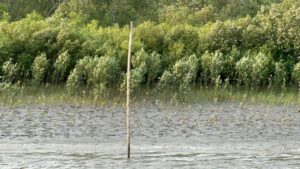 We did it! We said that we would do it and we did!
We reached the target of over a hundred thousand trees to mark the Soroptimist centenary. The #PlantTrees for a Brilliant Future challenge was embraced – a renewal – the very first Soroptimist pledged to save the Redwood trees back in 1921.
Across the SIGBI Federation, clubs and individuals across the world donated to make this dream project a resounding success, an exercise in partnership and sisterhood. As for the mangroves, in a span of 15 months, 25,112 mangrove saplings are strong, crossing the target of twenty-five thousand.
Where did all this begin? Concerned with the continual damage of the Delta Region at the head of the Bay of Bengal, the Soroptimists of SI South Kolkata explored ways to halt the environmental degradation there. Partnering with Kolkata Society for Cultural Heritage working at ground zero was a bonus. SISK dared to dream big, dared to accept the challenge of protecting the coastline so vulnerable to the fury and rage of the oceans.
More clubs joined in and soon by word of mouth and missionary zeal, the determination to restore the mangroves took top priority.
The area, known locally as the Sundarbans, has been ravaged by repeated cyclones in the past decade, falling down trees, eroding the soil, filling it with brine and debilitating the already vulnerable region. In fact, several low-lying islands were washed away. The Sundarbans, spanning India and Bangladesh, is the world’s largest contiguous mangrove forest and a UNESCO World Heritage Site, renowned for its massive tidal halophytic ecosystem and the Royal Bengal tiger. Covering 10,000 kms squared at the Ganga-Brahmaputra-Meghna delta, it is vital for biodiversity, facing, however, severe climate change threats.
Mangroves provide biodiversity, store carbon, arrest global warming keeping our planet cool, prevent soil erosion, and when more than 6-metres tall, they can reduce cyclonic waves by about 60%, thus arresting cyclonic damage. The Sundarbans is home to the widest biodiversity from the tiny bee to the Tiger. The entangled mangrove roots form a safe habitat for shrimp, crabs, and many other small creatures and marine species creating food security for humans.
Moreover, mangroves have provided the marginalized traditional communities, who are one with the mangroves, with livelihood and income generation.
Restoring the mighty mangroves at the Sundarbans, has not only created great awareness of this biodiversity and the importance of saving it, but also restored some stability to the disadvantaged communities, women participating in planting seeds and nurturing mangrove saplings to restore their region.
The mighty mangrove, however, is a baby right now. The earliest seeds planted are about 4.5 feet high. At low tide, we can see the young saplings, the soldiers of tomorrow, twenty-five years on…and the regeneration continues. What Soroptimists everywhere would be proud of is how community women have participated in the restoration of their region; Soroptimists have been part of that mighty regeneration.
Location Link: https://goo.gl/maps/H9wbYV2SYVwyoUyB8
Latitude and Longitude: 22°07’52.8″N 88°48’34.1″E