


 Men and Boys – Your Health Matters – Get Informed – Get Treated – Get Vaccinated
Human Papillomavirus (HPV) is a common viral infection that’s passed between people through skin-to-skin contact. Most infections are fought off by the body’s immune system and cause no symptoms.
However, HPV-16, the same virus associated with cervical cancer, is also linked to mouth cancer in younger people who are otherwise in good health and have no history of either smoking or drinking alcohol.
HPV related cancers are the fastest-increasing type of mouth cancer; fortunately, HPV mouth cancers appear to be more responsive to treatment, and the survival rate is much better than for non-HPV cancer.
What is Mouth Cancer?
This is the general term for the variety of malignant tumours that develop in the oral cavity and include the throat (pharynx), voice box (larynx), salivary glands, nose, paranasal sinuses, lips and skin.
HPV mouth cancers tend to appear at the back of the tongue, the back of the throat, and the tonsil area, while non-HPV-related mouth cancers involve other parts of the mouth.
Facts About Mouth Cancer:
- Worldwide, Mouth Cancer affects 650,000 people per year
- There are 10,825 new cases in the UK each year
- Every year, 3,637 lives are lost to Mouth Cancer
- More people in the UK die each year of mouth cancer than of cervical cancer and testicular cancer combined
- Mouth cancer is twice as common in men as in women
- 78% of cases occur in the over 55 age group
- 53% of mouth cancers appear on the tongue and tonsils
- Up to 25% of mouth cancer cases have no associated significant risk factors
- Incidence has risen by 49% over the past 10 years
The 5-year survival rate has hardly improved over the past 3 decades due to late detection, but if detected early, there is an excellent chance of a complete cure.
As reported by the Mouth Cancer Foundation, around 77% of UK adults have now heard of mouth cancer. However, alarmingly, awareness of the major signs and symptoms is as low as 20% and understanding of the risk factors is poor at only 8%.
Symptoms:
- A lump or swelling anywhere in the mouth, jaw or neck that persists for more than 3 weeks.
- An ulcer, or a red or white patch anywhere in the mouth that does not heal within 3 weeks.
- Difficulty swallowing, chewing or moving the jaw or tongue.
- Numbness of the tongue or other area of the mouth.
- A feeling that something is caught in the throat.
- A chronic sore throat or hoarseness that persists more than 6 weeks.
Risk Factors:
- Tobacco use is the main cause of mouth cancer.
- Drinking alcohol to excess can increase risks fourfold.
- Drinking and smoking together can make mouth cancer up to 30 times more likely to develop.
- The human papillomavirus (HPV) could overtake tobacco and alcohol as the main risk factor within the next decade.
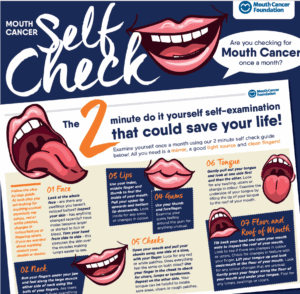
Are you checking for Mouth Cancer once a month?
The 2 Minute self-check that could save your life!
- Face: Look at the whole face – are there any swellings you haven’t noticed before? Turn your head from side to side – this stretches the skin over muscles, making lumps easier to see.
- Neck: Run your fingers under your jaw and feel along either side of your neck – are there any swellings? Does everything feel the same on both sides?
- Lips: Feel inside your mouth; pull your upper lip upwards and bottom lip downwards. Look for any sores or changes in colour.
- Gums: Examine your gums, feeling around for anything unusual.
- Cheeks: Open your mouth and pull your cheeks away, one side at a time. Look for any red or white patches; use your finger to check for ulcers, lumps or tenderness. Does everything feel the same on both sides?
- Tongue: Gently pull out your tongue and look at each side; check for any swelling, ulcers or changes in colour. Examine the underside of your tongue by lifting the tip to the roof of your mouth.
- Floor and Roof of Mouth: Tilt your head back and open your mouth wide to inspect the roof of your mouth. Then lift your tongue up and look underneath at the floor of your mouth. Finally, gently press your finger along the floor of your mouth and under your tongue. You are looking for any changes to colour and texture, ulcers, swellings and lumps.
Since 2008, the UK has had a highly effective HPV vaccination programme to protect young people against HPV related cancers. It is delivered in schools, and was initially for girls aged 12 to 13, then in 2019 it was extended to boys the same age.
However, vaccination uptake rates have continually declined, with no region achieving pre-pandemic levels.
The 2024 statistics published by the UK Health Security Agency highlight that approximately one in four adolescents still leave school without being vaccinated.
National rates for Boys were all well below the World Health Organisation’s 90% target:
- Year 8 (12-13 years old) boys – Coverage was 67.0%
- Year 9 (13-14 years old) boys – Coverage was 70.5%
- Year 10 (14-15 years old) boys – Coverage was 70.5%
- London recorded the lowest uptake for boys, at 57.7%
Boys must commit to being vaccinated to protect girls from cervical cancer, themselves from HPV-related penile and anal cancer and help them avert the risk of neck and throat cancers later in life.