

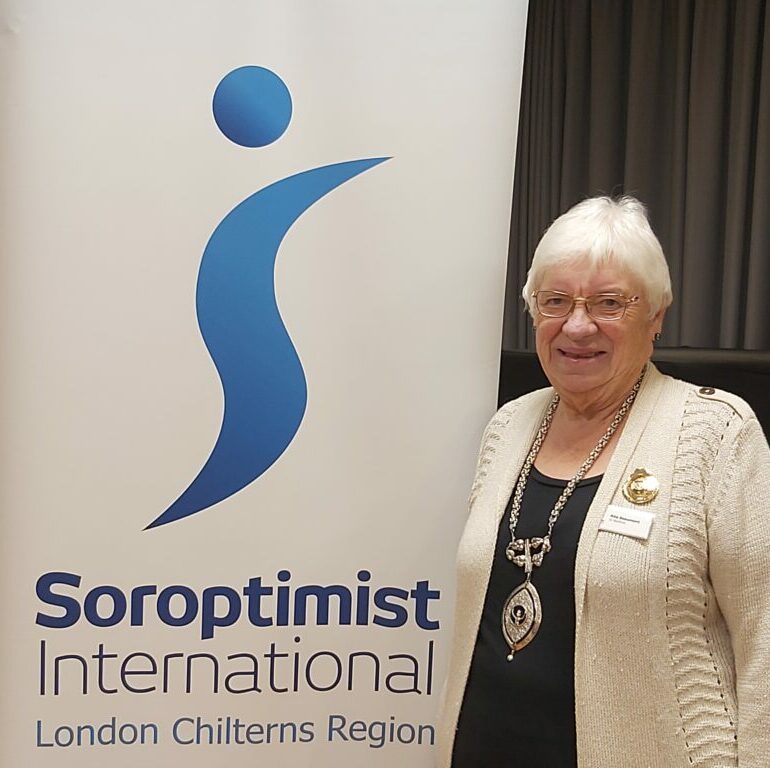
 Soroptimist International London Chilterns Region Human Rights Day celebration on Sat 13 Dec was very moving. It was the first event for President Rita Beaumont’s theme for the Region of “Good Health and Wellbeing – the Right of Everyone”.
The United Nations Human Rights Day Theme for 2025 is: “Human Rights, Our Everyday Essentials” https://www.un.org/en/observances/human-rights-day
 Members were encouraged to wear something orange because Human Rights Day marks the end of the “Orange The World” campaign – 16 Days of Action to End Violence Against Women. As a bright and optimistic colour, orange represents a future free from the scourge that is violence against women and girls. www.unwomen.org/en/what-we-do/ending-violence-against-women/unite/orange-the-world. In the photograph Members are holding a hand out as a symbol to stop the violence.
 Our Keynote Speaker was Major Kathy Betteridge, Director of Anti Trafficking and Modern Slavery for the Salvation Army https://www.salvationarmy.org.uk/modern-slavery who gave an update of the Salvation Army’s work with survivors.
You can view Kathy’s presentation slides here: Modern Slavery SILC HR Day 13.12.25
Helen Byrne introduced Kathy, who is a member of SI Enfield, a Major in the Salvation Army and Director of the Anti Trafficking and Modern Slavery Service. The Salvation Army provides specialist support to protect and care for all adult survivors of modern slavery in England and Wales through a government contract which was first awarded in 2011. They also have a specialist international team that partners with Salvation Army territories across Africa, Europe, the South Pacific and East Asia on protection and prevention projects. Kathy spoke at our Region’s Human Rights Day Meeting three years ago https://sigbi.org/london-chilterns/human-rights-day-2022/ so it was time for an update, including more information about the health needs and outcomes for the victims they support – in line with President Rita’s theme of “Good Health and Wellbeing”.
 Kathy’s presentation was about the Salvation Army’s work in combating modern slavery and trafficking. She provided an overview of the Salvation Army’s history in this area, including their role in raising the age of consent in the past, and shared updates on their current efforts to support survivors of modern slavery in England and Wales. The Salvation Army delivers the government contract and providing wraparound support through the European Convention Against Trafficking (ECAT) entitlement. She explained that the ECAT law, introduced in 2005, offers victims the right to housing, financial support,
  medical and legal assistance, education, and counselling. Kathy noted a decrease in the number of victims entering their services, attributing it to fears of deportation and conflation of modern slavery with immigration. She emphasised the importance of their international work, including a successful case where a Romanian woman and her daughter were reunited with the help of a Salvation Army contact person. Kathy also described various support activities funded by the Survivor Support Fund, such as animal therapy, gardening, dance and yoga workshops, and a photography exhibition.
Kathy answered lots of great questions. She explained that they offer a 45-day support service and facilitate volunteering opportunities for survivors. She clarified that victims of modern slavery rarely arrive by boat and emphasised the need to separate modern slavery issues from immigration discussions. The group discussed concerns about potential changes to the Modern Slavery Act and European legislation, with Kathy noting that while funding for violence against women and girls is currently prioritised over modern slavery, an extensive review of the Act is underway.
 The service is always looking for more volunteers. Jonaki Ahtek, a member of SI Greater London volunteers as a First Responder and Helen read her update which you can read here: Anti-Trafficking Jonaki Ahtek First Responder
If anyone is interested in finding out more about being a First Responder please email silondonchilterns@hotmail.com and we can put you in touch with Jonaki. Jonaki is likely to be doing some refresher training in the New Year and is very happy to help co-ordinate if you would like to join her taking the training.
The Region made a donation of £75 to the Survivor Support and if anyone wishes to make a further donation please email silondonchilterns@hotmail.com and we can send you the details.
In the next part of the meeting Regional Secretary Joanna Swift led the roll call of Members, and then asked Members to receive the Officers’ Reports which had been previously circulated. Regional Membership Officer Helen said that she would be organising an online catch-up with Membership officers and also a Zoom meeting for new Members in the New Year.
President Rita then led the group’s celebration of United Nations Human Rights Day and the 77th Anniversary of the signing of the Universal Declaration of Human Rights in the context of the Region’s theme of “Good Health and Wellbeing – the Right of Everyone” and the United Nations Human Rights Day Theme for 2025: “Human Rights, Our Everyday 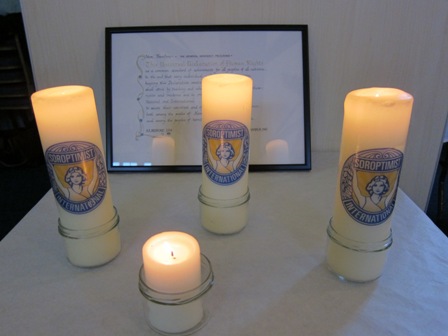 Essentials”. This part of our Human Rights celebration is always very moving with the candle-lighting ceremony providing a pause for thought and reflection.
The Universal Declaration of Human Rights is the milestone document proclaimed by the United Nations General Assembly in Paris on 10 December 1948 , and has inspired, and paved the way for, the adoption of more than seventy human rights treaties, applied today across the world. Eleanor Roosevelt, Chair of the Declaration of Human Rights Drafting Committee famously said: “Where, after all, do universal human rights begin? In small places, close to home – so close and so small that they cannot be seen on any maps of the world. Such are the places where every man, woman and child seeks equal justice, equal opportunity, equal dignity without discrimination. Unless these rights have meaning there, they have little meaning anywhere. Without concerned citizen action to uphold them close to home, we shall look in vain for progress in the larger world.”
The following is part of a statement made by Hina Jilani on 10th December 2025 as a member of The Elders, an influential independent group of global leaders working for peace, justice, human rights and a sustainable planet; it was founded by Nelson Mandela in 2007 www.theelders.org: “Human Rights Protect What it Means to be Human”. Seventy-seven years ago today, the Universal Declaration of Human Rights became the first global statement that every person – regardless of nationality, background, belief or other status – deserves fundamental freedoms. This document was born from humanity’s darkest hours. After witnessing the horrors of World War Two, the world understood that it could not rely on goodwill alone to protect human life, equity and liberty. Its principles continue to underpin global standards of dignity and equality that guide laws, inspire social progress, and help protect peace. At their core, human rights protect what it means to be human.
But we are now in a troubling era of growing geopolitical division and disregard for international law, as conflicts intensify. While the world vowed ‘never again’ after the Holocaust, that commitment has often gone unfulfilled. Post-war reconciliation demonstrated that lasting peace requires accountability, rights-based solutions and rebuilding trust – not vengeance. Today, as the world confronts overlapping threats – from the climate and nature crises to pandemics, nuclear weapons, and the dangers of unchecked AI. International law and human rights must be at the centre of any meaningful global response. ‘Everyday Essentials’ is the official theme for this year’s Human Rights Day. It is an important reminder that human rights shape our everyday lives, often in ways we do not realise. Many of us take human rights for granted, as something that will simply endure without our vigilance. We must not forget that universal rights and freedoms can never be embodied and protected by declarations alone. It is people who embody and breathe life into human rights. It is people and their leaders who bridge the gap between lofty human rights agreements and the situation on the ground. Without these people, the Declaration amounts to nothing more than a hollow commitment. We must not only dream of a more just world but have the courage to fight for it.
Hina Jilani: Advocate of the Supreme Court of Pakistan, co-chair of the Taskforce on Justice & Human Rights Campaigner , December 10th 2025
https://theelders.org/news/human-rights-protect-what-it-means-be-human
Reading 1
“Without women, there can be no lasting peace” Denis Mukwege calls for justice for survivors of sexual violence and for women’s full participation in peacebuilding and is taken from a statement made as a member of The Elders on 13th November 2025
https://theelders.org/news/without-women-there-can-be-no-lasting-peace. Reader: Barbara Bramley, SI Greater London
The first candle was lit for: women to be allowed to participate fully in the processes to achieve a lasting peace in many areas of a troubled world : without women there can not be a lasting peace.
Reading 2
Digital Violence is Real and how Pakistan’s Anti-Rape Crisis Cells are transforming support for survivors and is taken from a UN Women statement at the beginning of the 16 Days of Activism Against Gender-Based Violence 2025
https://www.unwomen.org/en/news-stories/feature-story/2025/11/how-pakistans-anti-rape-crisis-cells-are-transforming-support-for-survivors.
Reader; Lynne Tedik, SI Milton Keynes
The second candle was lit for: continued measures to be taken to stop violence of all kinds against women and girls wherever they live.
Reading 3
The Story of Noor a little girl in Syria, supported by Humanity and Inclusion after she was badly injured in the earthquake of 2023
https://www.hi-us.org/en/news/noor–walking-her-way-back-to-life–
Reader : Anne Miles, SI Hertford & District
The third candle was lit for: the provision of universal healthcare wherever and whenever it is needed and for those who provide it, despite at times putting their own lives at risk in areas of natural and man made disasters.
Reading 4
What is it like to be a Woman in Afghanistan in 2025? taken from a report by UN Women in August 2025 https://www.unwomen.org/en/articles/faqs/faqs-afghanistan
Reader: Smita Bora, SI Thames Valley
The fourth candle was lit for: Soroptimists across the world who advocate for the Human Rights of Women and Girls everywhere : human rights protect what it means to be human (Nelson Mandela).
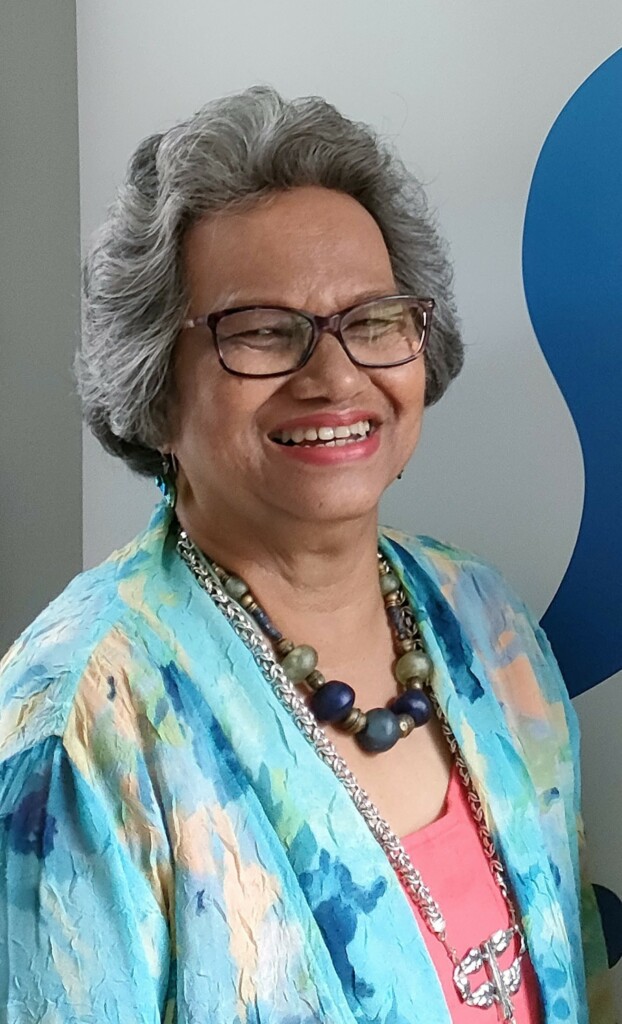 Our second speaker was SIGBI President Elect Kate Belinis. Kate had attended the High Level Roundtable “Shaping an Equitable Future with AI” at Marlborough House in London. This important event was organised by Soroptimist International in partnership with the Commonwealth with a list of influential speakers and delegates invited to participate. The meeting focused on Soroptimist International’s engagement with AI and its implications for gender equality. Kate shared insights from a recent Commonwealth roundtable on AI, highlighting the need for human-centric development and addressing gender bias. The roundtable agreed that Artificial intelligence must be shaped so that it narrows, rather than widens, the gaps that all women and girls already face in education, work and access to technology. You can read more about the event here: https://www.soroptimistinternational.org/2025/12/02/soroptimist-international-and-the-commonwealth-convene-high-level-roundtable-on-ai-and-equality/
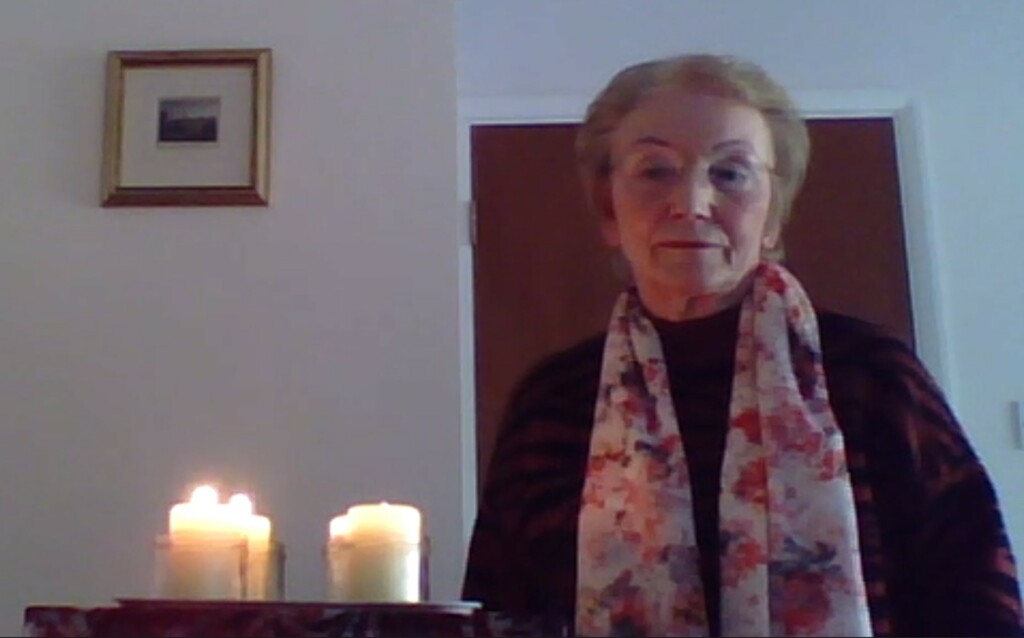 The final important part of the day was on Programme Action – led by the Region’s Programme Action Officer, Pam Robertson.
Pam was able to show a video presentation about Cervical Cancer Awareness in India which was delivered at the Soroptimist International Great Britain and Ireland (SIGBI) Conference Oct 25 in Birmingham. The presenter is Shukla Chattopadhyay, Assistant Programme Director SIGBI and President of the SI South Kolkata Club in India – click here to view it:
Pam reminded Clubs to submit program action forms to database for their amazing “16 days” “orange the world” to end violence against women and girls campaign activities.
Pam also asked Clubs to consider entering their projects for next year’s SIGBI “Best Practice Award”.
Clubs are encouraged to participate in the upcoming social media project on women’s safety when it launches.
The meeting ended with the notice that the Region’s next event is the International Women’s Day Celebration on 14th March 2026 at the Lancaster Hall Hotel in London. Details will be sent to Clubs, please ensure the date is in your diary because this is always a memorable event for Soroptimists. Guests will be very welcome.