

Easby Abbey
We held our July Meeting at Easby Abbey, the English Heritage ruins on the edge of Richmond. The evening began with a picnic in the grounds on a lovely evening, which was followed by a tour and talk about the history of the Abbey by Kate Streatfield, one of the English Heritage custodians.
Evidence suggests that a religious community of some sort existed on the site before the abbey was founded. This was probably based on the surviving parish church of St Agatha, and may have been an Anglian minster, a community of priests responsible for serving the surrounding parishes. The Abbey itself was founded in about 1152 by Roald, constable of Richmond, and may have absorbed the earlier minster. It was a Premonstratensian Foundation, only the third one in England.
Most of the Abbey was built in the 13th century.
The Premonstratensian order was founded in 1121 in Prémontré, France, by St Norbert of Xanten. Most monks followed the 6th-century Rule of St Benedict, renouncing the world for a contemplative life. Norbert elected instead to follow the older Rule of St Augustine, which better fitted his aims that Premonstratensians should serve communities by preaching, teaching, charitable work, and sometimes by direct service as parish priests. Nonetheless, the Premonstratensians were heavily influenced by the Cistercian order, borrowing their rules for founding abbeys, the use of lay brothers to carry out much of the manual work for the community, and the regulation of daily life. The Premonstratensians adopted white robes like the Cistercians, and were known as ‘white canons’.
The Abbey was suppressed by Henry VIII in 1536, following the establishment of the Church of England. The lands were sold off, and the buildings rapidly lapsed into ruin. Stone was taken for building, and some substantial pieces were taken away – a choir screen which is in St Mary’s Church, Richmond and another screen in Wensley Church. The estate was sold in the 18th Century to William Smith of Melsonby, who built a hospital and Easby Hall. The ruins became an object of interest for antiquarians and Romantic artists in the 18th and 19th centuries. The grandeur of the surviving buildings testifies to the success and wealth of the abbey.
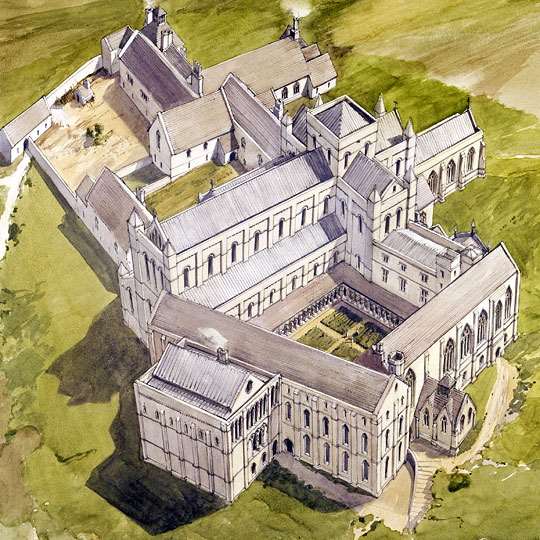
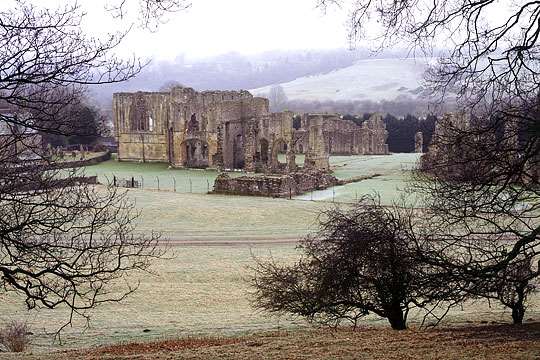
In the 1950’s the Custodianship of the Abbey was given to the Ministry of Works, and was passed to its successor in charge of national monuments, English Heritage when Margaret Thatcher was Prime Minister. English Heritage is now an independent Charity. Below is an illustration of what the Abbey would have looked like when it was fully built and in use and a photograph of the current ruins.
Business
A brief business discussion followed the talk, which included the welcoming of 2 new members.
We will be holding a fundraising Bingo Night at Richmond Town Hall on Friday 17th October 7pm for 7:30pm, in aid of this year’s charity, with proceeds going to Palliative Care Richmond & Hambleton. We will obtain a temporary liquor license to hold a bar for the night. There is a sub-group organising this.
Wendy will be reviewing our PA reports and see if any are suitable to go forward for Regional awards in September. We are hosting the September SI Yorkshire Regional Council Meeting at the Scotch Corner Hotel, as our member Judith will be the new President. Members will be acting as club ambassadors to meet and greet our visitors. There will be “show and tell” tables for clubs to demonstrate their Programme Action work. We will be showing
- details of the Swimming Packs we funded
- the folder of entries from our International Women’s Day “Women of Richmond” exhibition
- examples of the tote bags for young people in care which we have been making. We hope to encourage other clubs to make some too!
As the Club has it’s Summer Break in August, the next meeting will be our annual visit to Colburn Community Support at Colburn Village Hall in September. Members were reminded to bring contributions towards their Christmas Hamper Appeal, as usual. Food staples such as pasta, tinned soup, tinned beans, tomatoes, corned beef, and ham are requested, and toiletries suitable for teenagers. Fray Bentos pies as well as Christmas treats such as small Christmas cakes, packets of biscuits, chocolate treats are really welcome. They will have a “warm rail” for donations of good quality warm clothes for adults and children, and a toy appeal for children for new or nearly new toys.