

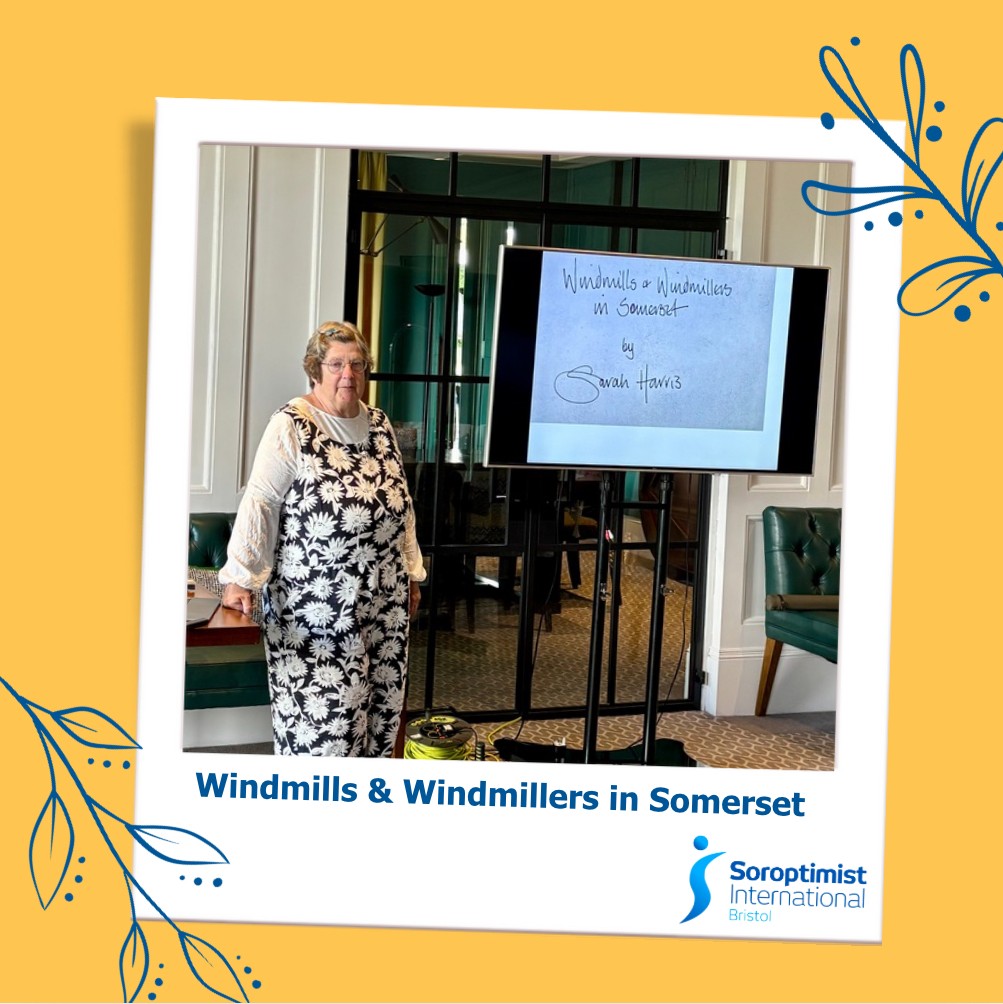
At our Speaker meeting on 14th July we had a most interesting and entertaining speaker in Sarah Harris who talked about Windmills and Windmillers in Somerset.
We learned that the Romans brought the technology of wind power to Britain, and then the technology came from Yorkshire to Somerset.
The Post Mill, common in Somerset, is the earliest type of European windmill. Its defining feature is that the whole body of the mill that houses the machinery is mounted on a single central vertical post. Post mills were only for grinding corn.
Sarah told us that the miller in those days was like the white van man from the Middle Ages. Although a necessary member of rural communities, the miller was often unpopular, regarded as mean-spirited and sometimes a cheat, taking more money than he was entitled to.
In Somerset, the 18th century Ashton Mill in Chapel Allerton, near the village of Star on the A38, last worked in 1927, but has been carefully restored. It is a grade ll listed building with slatted sails. It is the only mill in Somerset with a complete set of working machinery.
Stembridge Tower Mill in High Ham, Somerset, is the last remaining thatched windmill in England. The mill is a grade II* listed building, built in 1822 with four floors and a thatched “cap”. It is a National Trust property, restored in 1971/74 and 2009.
Windmills were always more difficult to run and maintain than watermills, we learned. Dependant on the wind, they were less reliable than water powered mills for certain tasks.
Despite their enormous machinery, windmills ran with about one horse power. One surprising fact we learned from Sarah was that the best mill stones came from Paris!
Today’s talk was thoroughly informative and delivered in a very relaxed and amusing way. We all enjoyed it very much, so a big thank you from us to Sarah Harris!