History has sought to challenge the patriarchal, dominated world in which women and girls live and work, causing many women (and girls) to take a stance and fight for a safer and more equitable society, one in which we can all prosper. 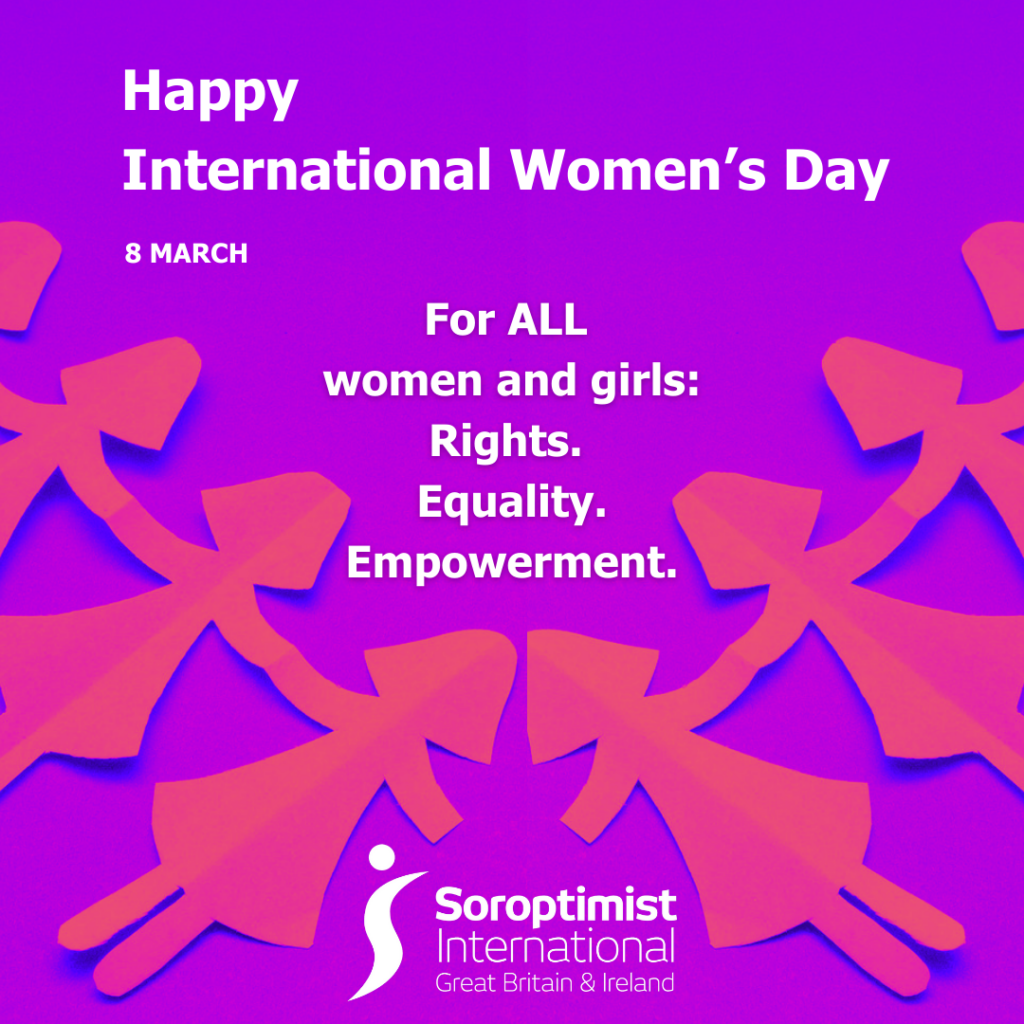 Disappointingly however, despite many global and landmark successes, there is still a long way to go before we have created a more just society in which women and girls can attain their rightful place. A place where gender domination is brought to an end.
One such success is the establishing by the United Nations (UN) of International Women’s Day, a day through which we can all come together and promote an awareness of the impact of the discrimination and hatred directed at women and girls. A phenomenon which leads to intense fear, torment and suffering. Even death.
International Women’s Day was first marked by the United Nations on March 8th 1975, during International Women’s Year. Two years later, the UN General Assembly officially formalised the day, which has since become ingrained in international practice.
This year’s theme – For ALL women and girls: Rights. Equality. Empowerment calls for action that can:
“unlock equal rights, power and opportunities for all and a feminist future where no one is left behind. Central to this vision is empowering the next generation – youth, particularly young women and adolescent girls – as catalysts for lasting change”.
Despite the inroads we have made in challenging the patriarchal domination that continues to exist, disappointingly, much more needs to be done. Because women and girls continue to be trafficked, abused and killed simply because of their gender. In a civilised society, this is grossly unacceptable and a violation of gender rights.
Within the UK much has been achieved through a number of All-Party Parliamentary Groups (APPGs). Such groups aim to raise awareness and inform government of the impact of for example, domestic violence through the APPG on Domestic Violence and Abuse. Furthermore, the APPG on Women’s Health aims to raise awareness of health conditions that affect only women or women disproportionately. There should be no need for these groups. Sadly, there is.
A variety of organisations exist that have taken up the challenge to make the world a safer place for women and girls. Soroptimist International is one such organisation.
First formed in 1921 in California the name Soroptimist was coined from the Latin soror meaning sister, and optima meaning best and so is perhaps best interpreted as ‘the best for women’. Members of Soroptimist International:
‘work tirelessly at both a local, national and international level to educate, empower and enable opportunities for women and girls’.
Membership is open to all women who want to make the world a safer and better place for women and girls to live and to access opportunities that enable us to thrive and achieve our potential. We may not eliminate gender equality in our lifetime, in fact, it’s unlikely we will, but we can change the lives of women and girls for the better – we just need to act. We just need to ‘grasp the nettle’. So why not take a look at the rest of our website. Can you spare a few hours to make the lives of our daughters, our nieces, our granddaughters better and enable them to achieve their full potential.
Or if you prefer contact me Catherine Best at Catherine.best23@gmail.com to find out how you can become involved.
This blog was first published in 2024 for International Women’s Day by the Queens Nursing Institute (QNI). It has been altered slightly to reflect the changes made in 2025. I would like to thank the QNI for allowing me to republish some of this work.