

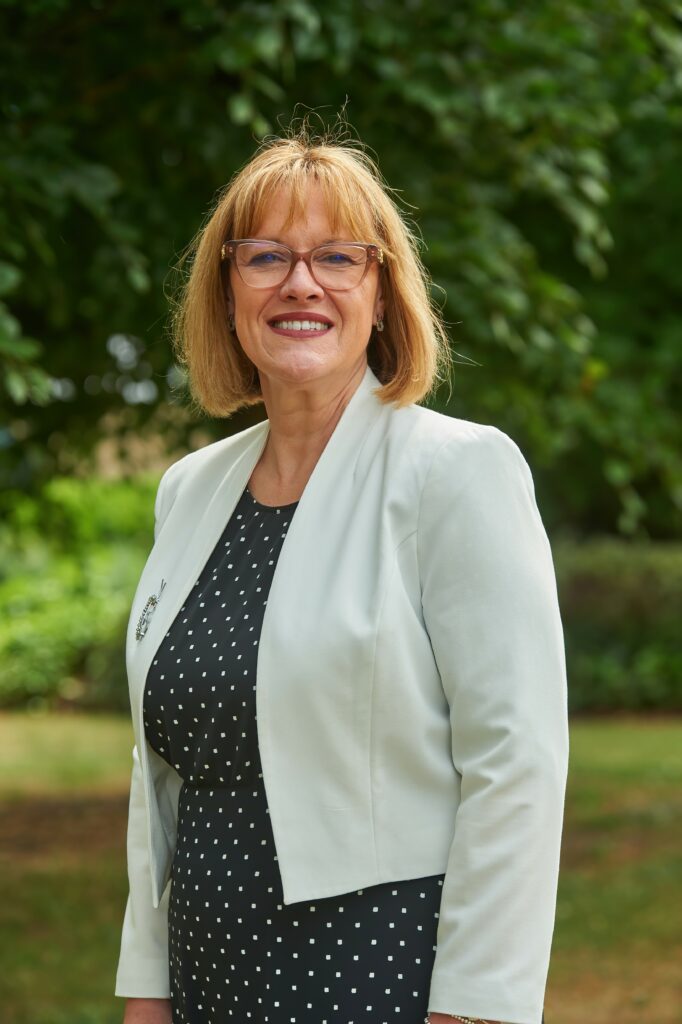
Soroptimist International St Albans & District were delighted to welcome senior educationalist Margaret Chapman, Co-Chief Executive of Ambition Education Trust, and long-time friend of the Club, to speak on Mon 26 Jan on Zoom. The event marked the United Nations (UN) International day of education. Soroptimists all over the world at a local, national and international level support the UN Sustainable Development Goal (SDG) 4 Quality education which aims to “Ensure inclusive and equitable quality education and promote lifelong learning opportunities for all.”
Margaret used a few slides with lots of images to illustrate her talk. Three screenshots from her talk for “past”, “present” and “future” are shown here.
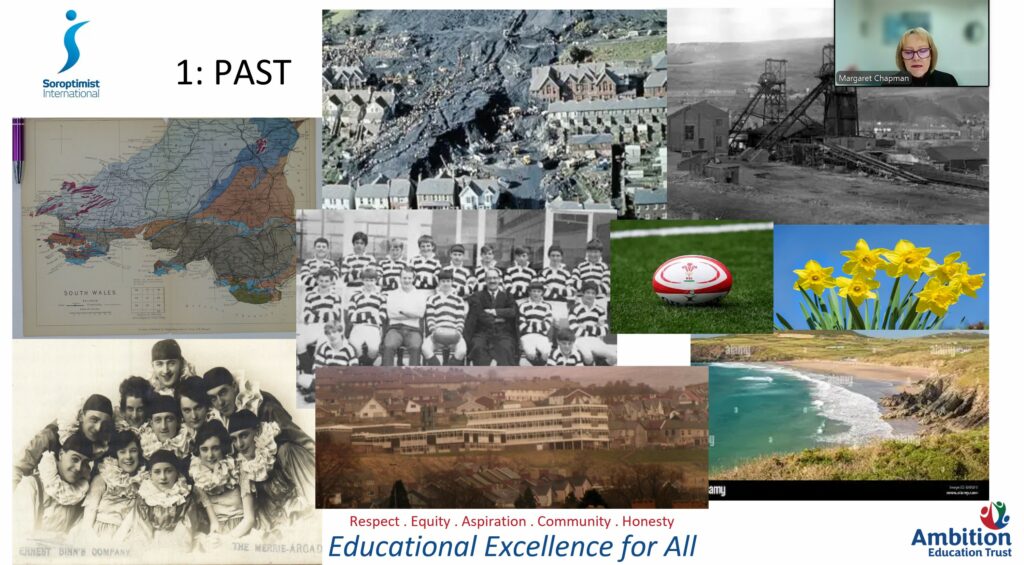 Margaret told us that for nearly 60 years her life has been impacted by education. She was born in 1966, the year when the Aberfan disaster cruelly took away the lives of most of the children in that Welsh village, when the village school was engulfed by an avalanche of waste from the local mines. Growing up in the South Wales Valleys, the daughter of a Headmaster, in a family committed to education for all, had a profound effect on Margaret’s early years. It gave her a strong sense of duty, and an understanding of the impact of landscape, community and social change on the lives of those around her.
Education was at the centre of her young life. It strongly influenced her move from the Valleys to the largest sixth form in Wales at the time, and her decision to reject the chance to study law at Balliol College, Oxford in favour of Geography and Geology at University College Aberystwyth, which she loved. Margaret identified several crossroads in her life and this was one. It led to a Postgraduate Certificate in Education (PGCE) in Aberystwyth and a career in teaching to which she brought originality, commitment and enthusiasm. Having witnessed the impact of poverty and unemployment in the valley communities as the mines closed, Margaret moved to England where in 1988 the introduction of the national curriculum caused controversy. While teachers had had the flexibility to teach whatever they wished, the experiences of pupils were very variable. In future, as the expectations on teachers were defined, they knew what was expected of them and children across England and Wales received the same content in their lessons.
Margaret’s career progressed as she took on a variety of roles in different schools in North London. She felt that opportunities for students were far greater than they had been in South Wales where young people did not have the aspiration and believe in what they could achieve. That did not mean that it was all plain sailing, but when faced with a group of boys in year 10 who were disaffected with their school experience she was able to get them the opportunity to work on a building site in school hours, learning a craft, getting paid, and ultimately gaining some qualifications.
During the 1990s, having become a Head of Geography in Mill Hill, Margaret told us that there was considerable money in education. She was involved in everything in the school and having married and had two children. she felt she could have stayed there forever. But Margaret always wanted to make a difference. She became involved with the London Challenge, working with schools facing such challenges as the lack of specialist teachers for A Level students, or requiring additional help and guidance to overcome practical problems. Not all schools benefitted from the additional resources available however, and, as Deputy Head in Hitchin, she was faced with a range of challenges including students who felt worthless as vandals attacked the premises, and the school environment deteriorated. As a catalyst for change, the staff obtained a grant which was spent on measures to tighten security, and limit the damage. The school also became a ‘Specialist School in Business and Enterprise’ and as a result of the staff’s evident belief in the potential of those pupils, raised their horizons too.
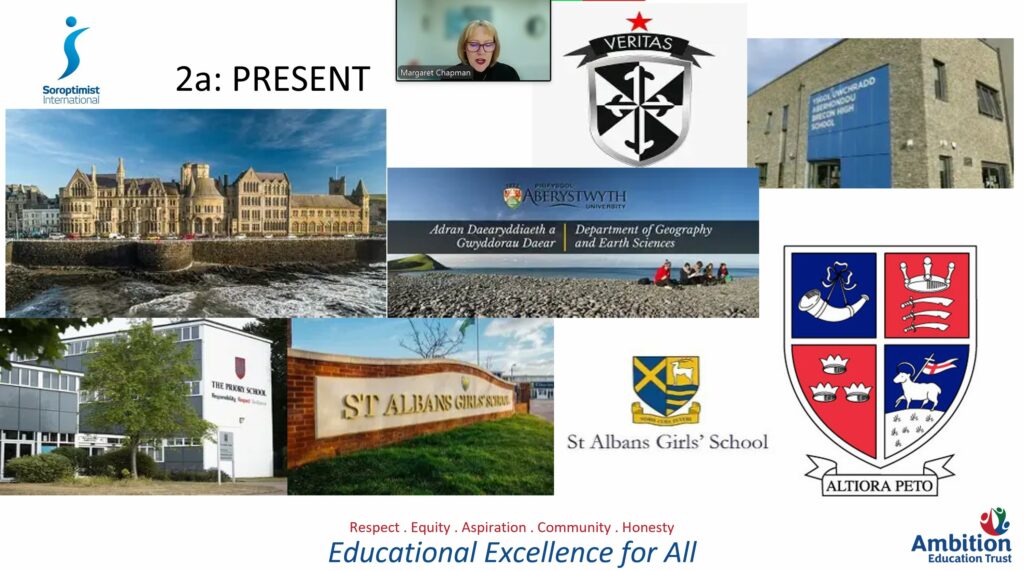 Margaret and her family had moved to St Albans and when the opportunity to apply for the role of Head at St Albans Girls School (STAGS) arose, having found it warm and welcoming at a 6th form open evening, she saw it as a sign. There was a job to be done, and having the chance to raise the glass ceiling for girls was, she felt, a great privilege and gave her much joy. The school achieved an Outstanding assessment from OFSTED in 2013 and wider involvement in development work in education followed. Margaret became a National Leader in Education, and was involved in the Pupil Premium, as well as continuing to work with the London Challenge.
By 2017 the landscape had changed. Schools in St Albans and its surrounding area were being asked to become academies. STAGS moved from being a single academy to a multiple Trust with an Executive Head.* This provides opportunities for colleagues in other schools, and offers improved opportunities for recruitment and retention. COVID’s impact is still being felt. Post-COVID, society has shifted and young people are still being affected. Margaret feels young people need the rhythm of life to sustain and nurture them so they can flourish, but words such as anxiety and nervousness are much more common today, and those at the margins are particularly affected.
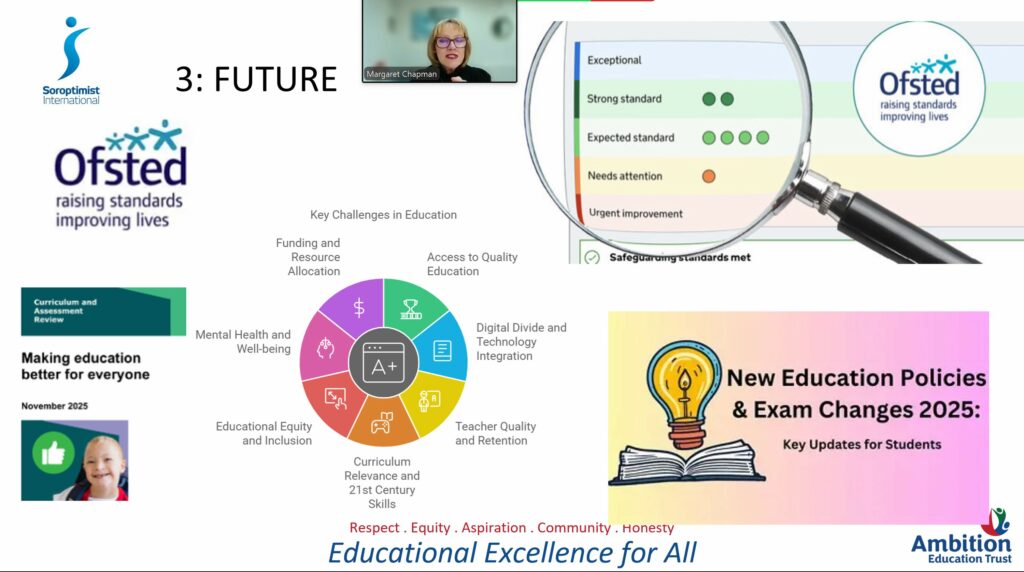 For them all, the future begins today and Margaret highlighted a range of Challenges facing those in Education and in Society at large. She cited:
● OFSTED’s new assessment framework published last November which is not yet understood
● The Curriculum and Assessment Review for implementation in 2028
● New exam policies and changes from 2025
● Teacher Quality and Retention
● Funding and Resource allocation
● Access to Mental Health and wellbeing
● Special Educational Needs and Disabilities (SEND)
● Attendance levels which are not at previous rates
● AI
● Use of phones in schools
Margaret has also set up the 28% Club to increase the percentage of women leaders in Hertfordshire, where despite the high quality of all the Head Teachers, 5 out of 6 girls’ schools are led by male Head teachers. It begs the question where are the female leaders in our schools?
Moreover, evidence shows that ¼ children starting school are not toilet-trained. Similar proportions are scrolling not turning the pages in a book. Parents are not engaging their children in conversation, despite the duty we have as adults to engage with the next generation and support them. Margaret is extremely worried about how adults walking in a park concentrate more on their phones than their children and pets. She asks, ‘what are we doing to the wonderful young people about to embark on their education?’ These issues certainly worry her.
At the end of her speech, Margaret reminded us of the hope instilled by Malala Yousafzai who said. “Education is crucial because it is the path to freedom, equality and empowerment, giving girls choices, breaking cycles of poverty, fostering peace and enabling them to reach their full potential as leaders, innovators and citizens, directly countering extremism and injustice.’ Malala views education as more than just schooling. She says that it’s a lifelong journey of critical thinking, building compassion and understanding shared humanity, of learning to transform the lives of the world. This remains so powerful and important for women and girls. We live in a changing world for all young people, and in Margaret’s view this poses big challenges for them more so than ever before.
Margaret believes that every child deserves a champion to ensure their best possible education, aspiration and life chances for as Nelson Mandela said “Education is the most powerful weapon to change the world”.
As Soroptimists, we have been privileged and inspired to share her story and her wisdom, and we thank her most warmly for the time she spent and the insight she has given us.
*Ambition Education Trust whose motto is “Educational Excellence for All”, includes 10 schools across Hertfordshire in St Albans, Welwyn and Hemel Hempstead. It includes 3 primary schools, one infant and one junior, and five secondary schools. A staff of 800 provide education for over 7500 students aged from 3 to 18. It is some task! But In addition to Margaret’s important role in the Trust, she has set up a national initiative called the 28% Club to improve the number of female Head Teachers at secondary level.
There was no charge to attend this event. If you wish to make a donation to the Club’s educational projects which include The Steve Sinnott Foundation and the SIGBI Diamond Education Grant, please understand there is no pressure to do so, the bank details are on this page of the website: https://sigbi.org/st-albans-and-district/donate/.